fredag 30 juni 2023

Leger vs. Final Fantasy (NES)

Even though Phantasy Star on the Master System and Final Fantasy on the NES are almost by date (December 1987) the same age they seem like games from two completely different eras when it comes to the technology they present to the player.

Also, since the Swedish publisher of NES games, Bergsala, and others involved thought of role playing games as too text heavy and not particularly much of a good fit with the public considering its age we never got to see Hironobu Sakaguchi's Final Fantasy back then.

Or Dragon Quest.

Or any jrpg at all, on the NES.

The Master System got Phantasy Star, Miracle Warriors and Ys: The Vanished Omens (the last one being an action adventure with role playing elements). Even the Mega Drive happened over here, with Phantasy Star 2 and other jrpgs before Nintendo and Bergsala caught up with the interest.


The point I am reaching for is that when I finally got to play the very first Final Fantasy (probably emulated in the second half of the ninties) the game felt archaic even by the standards of 1987.

Where Phantasy Star offered full blown 3D dungeons with animated movement, animated enemies and extremely detailed and colourful backgrounds on the battlefield Final Fantasy offered black backgrounds in battles, static enemies and graphics which even compared to the cartoony Dragon Quest of 1986 seemed, at times, simple.

Not to mention the fact that if a character is about to attack an enemy in battle but the enemy falls by the hands of someone else before the attack is carried through, the character lashes out at thin air instead of adapting to the situation and turn the interest to a still living enemy.

Also, the by now famous story about four heroes looking for a way to reactivate four crystals to save the world just felt... bland... especially compared to the revenge seeking Alis who lost her brother to the hands of evil.


This is not to say that Final Fantasy is a simple game.

Rather, it is a more open and dynamic journey than Phantasy Star, especially since the dynamics of the party is chosen by the player and not the story itself (as in Phantasy Star and Dragon Quest, with the latter not even offering a party at all).

See, if there is something that could be said about Final Fantasy and the way the player experiences the journey on offer it resides much in the choice of class of each character.

A Black Mage is good with offensive magic while a White Mage is good at defensive dito. The Red Mage can manage both white and black magic but lacks the ability to deal with the strongest magic on offer.

The Fighter is obviously a good fighter, the Thief is yet to become something I care to bother about and the Black Belt offers pure tanking; Such good fighters, deals massive amount of damage but is lacking in defense even though higher levels balances things up aswell as some of the armor and other defensive equipment that they can use.

Oh, and when reaching a certain point in the game all of the classes can evolve into something more advanced which enables use of more advanced equipment and magic.


So, depending on the choices made before the journey begins the game will feel quite different.

While I usually (when playing the later versions of the game, such as the one on the Playstation Portable or iPad) go with two fighters and two mages this last trip, the first playthrough on the NES, had me picking four Black Belts.

Certainly grindy in the beginning, especially with the low defense, made for many deaths until my levels had reached a point where I actually could withstand larger groups of enemies.

And this is also a big difference compared to both Phantasy Star and Dragon Quest, where only one enemy (or one type of enemy, although many of them) could be encountered in a single battle.

In Final Fantasy up to nine enemies can be battled at once, where the player can pick and chose between which one to attack and how.

This makes for way more strategic battles, which is a good thing, especially since players just hammering the button will spend much time attacking nothing but air until the round ends and the next enemy in line automatically gets selected.


Playing with only Black Belts also meant that no magic could be used, and thus I had to stock up on potions pretty much before each trip to wherever.

Here it becomes painfully obvious how small Quality of Life changes in later versions of the game makes a world of difference; The menues are slow, you can only buy one item at a time and stocking up on 99 potions takes a couple of minutes.

Also, the game in itself is pretty slow.

You can not run, just walk, and while the random encounters actually are not as frequent as one would think the battles always feel sluggish.

Now, this would be a huge problem if the game was massive in scope or if leveling up took a long time or if reaching a higher level made no real difference.

But it makes a big difference leveling up, especially when it comes to the Black Belts which when using no weapons will attack more and more times with each blow if using only bare hands.

By the time level 20+ is reached they are extremely powerful and pretty much obliterates everything in their path as long as they do not encounter enemies that manage to kill them with one hit. This is particulary troublesome since Final Fantasy offer no way of reviving fallen characters outside of towns.


Furthermore, since the equipment Black Belts can use is scarce there is never really a lack of money that hinders progress. Most money will be spent on reviving fallen characters or bying potions, antidotes or cabins or houses (that allows the player to regain some health, some magic and save on the world map, the only place besides an inn where this is possible).

Playing this way made the first third of the game feel like a preparation for the two final thirds.

Reaching higher levels early made traversing land and caves, dungeons or castles much easier and when putting pure focus on progress and exploring previously unexplored places the game suddenly seemed to rush towards its conclusion.

Getting hold of a canoe to be able to travel on shallow water, a boat to do the same on deep water. Finding a gravity defying stone which pulls up a buried airship from beneath a desert. Finding items which opens up new pathways, talking to people and doing them some favours.

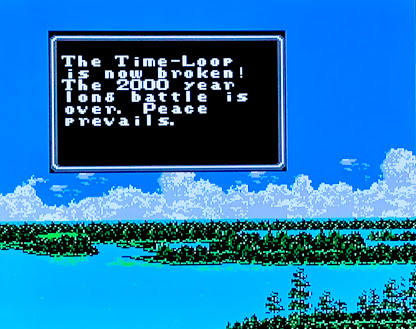
Beating the keepers of the ways to reactivate the crystals, the bosses linked to the four elements, and in a strange twist of happenings travel in time to break a loop which keeps the world in turmoil.


I could not stop playing.

Each session had me come up with a certain task to complete (reach level x, search through cave y, beat boss z, buy the best equipment available in a particular city and so on) aswell as a new task to deal with next time playing.

Most of the grinding was done while watching, for example, a movie to eliminate some of the monotonousness of it all.

And when I finally could see THE END on the screen I almost felt like starting again, from the beginning, with a different kind of party.

It may sound strange, but Final Fantasy on the NES managed to get me much more involved in the journey than the versions on PSP and iPad did.


I do believe this is due to the need of actually engaging in the gameplay, putting in commands in the battles and not just hammering away on attack, having to plan all of the trips by stocking up on potions and other items and knowing that some bad choices or bad luck could wipe out the entire party from one second to another.

This is simply not the case in the versions I have played earlier where you can save wherever and whenever you want. Where there is less need to engage in the battles since you do not have to think about the consequences of killing an enemy that another character is waiting to attack. Where less time is needed moving from one place to another with the help of the ability to dash.

You could say that I was somewhat surprised, since the archaic feel of the game put me off years earlier and had me thinking that I would never bother about beating this original version.

Instead, it made me actually appreciating the experience more especially considering when it was released and what other games at the time had to offer.

Sure, Phantasy Star is prettier, more streamlined and accessible to play today even without bothering about the later remaster with added QoL functions such as mapping of the caves and such.

Not to mention lacking all of the truly odd bugs to be found all over Final Fantasy on the NES (such as many weapons with certain characteristics not working as they should, some magics being broken and some glitching stat defining algorithms).

But Final Fantasy differs so much from Phantasy Star that it it is hard to directly compare what is on offer; They both have a relevant place in history and are both worth experiencing.

While the quite newly released Pixel Remaster, or any version from the one released on Game Boy Advance and onwards, would be what I recommend to those interested in experiencing the origins of the series without having to deal with most of the design choices which by the standards of today seem horrible...

...this original version could do more than well if being aware of its shortcomings, if looking at it from a perspective of when it was released and simply wanting to experience it all in the way it begun.

Almost baffled by my own opinon, but due to it being the odd case of me putting the experience above the product delivering that very thing.

Also, it is more than fascinating to see so many series mainstays appear in this very first installment such as the Black Mage, The Prelude (in its most basic form, an arpeggio which never ends) aswell as the victory fanfare (Nobuo Uematsu does a good job with the entire soundtrack, though his later work is in so many ways more memorable and more well defined), the airship and the crystals (here called orbs).

And as such, I just have to love Final Fantasy on the NES; An intriguing, entertaining (albeit slow and somewhat broken) and replayable piece of ridicilously important video game history.


söndag 11 juni 2023

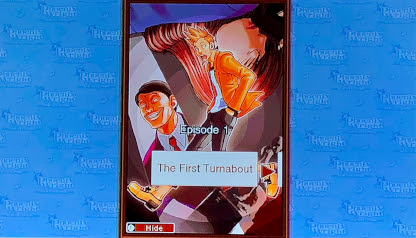
Leger vs. Phoenix Wright: Ace Attorney (Wii)

Initially planned for the Game Boy Color Phoenix Wright: Ace Attorney launched on the Game Boy Advance in 2001. Only in Japan, of course. It would take another four years until the port to the Nintendo DS made the game available for English speaking audiences and another five until console players could run the game on the big screen.

Of course I had to wait another thirteen years until I actually played the game, going backwards compatible on the Wii U where all my digital Wii licenses resides today.

Unless counting a bunch of old text adventures, mainly Infocom ones, my relation to the visual novel (which Infocom games actually are not) is no more in depth than the obscure and since long forgotten Lux-Pain on the Nintendo DS; A game I reviewed back in 2009.

I kind of liked it.

Thus, I have to question myself why I did not bother to explore the genre a bit. Taking on some classics, such as Snatcher or whatever.

Well.

Now I finally have.


Some basics, first.

Phoenix Wright: Ace Attorney is not just an emulation of the Nintendo DS version of the game.

Not that the graphics have been revamped to make use of the higher resolution, or that motion controls have been forced upon the player (besides the activation of the possibility to rotate evidence in 3D in a later stage of the game, or having the option of waving the wiimote to initiate certain actions)... but, well... yeah.

Thus, the graphics looks rather low resolution on the big screen (which I love, by the way) aswell as it is presented in a framed state and navigating the menues and moving the cursor on the screen during investigations are done with the d-pad and buttons (thankfully).

You could argue that Capcom have made the smallest effort possible without having to deal with a shitstorm of complains about the port.

But I could not care less, since the heart and soul of the game is in the writing and the presentation works just fine as it is.

Oh, and the fifth case originally added to the Nintendo DS version of the game is an optional DLC in this version.


Now, as for the game it is divided into two separate parts.

The courtroom trials, where our hero aswell as rookie attorney Phoenix Wright defends his clients by cross-examining witnesses by trying to find faults within their testimonies.

Pressing for more wording on certain topics, presenting evidence that proves this or contradicts that. Answering questions from the judge or other involved persons.

And the investigations, where places are visited, people talked to, clues looked for and whatnot in hope of bringing more things to work with during the trials.

This is repeated over the course of five cases, which over time seems more interconnected than not much thanks to the reappearing characters and storylines that follows them.


As a game Phoenix Wright: Ace Attorney have some apparent issues which at times brings the flow of the story to a halt.

During the investigations it may be more than unclear exactly what the game wants the player to do and in which order to progress the story... no matter how crystal clear the solution to a certain problem may be.

Maybe you have to show a particular item to a specific person to get the chance of asking a certain question, leading to showing exactly everything you have access to just to be sure not to miss out on something.

Over and over and over again.

Getting stuck during the invastigations is such a bore, and while the trials can be rather frustrating aswell for example when trying to find out exactly WHEN to present WHAT evidence they bring with them nothing like the annoyances in the investigations.

Just look up the solution to your problems in a walkthrough, it will be worth it.


Out of the five cases the first one acts as a tutorial of sorts. The rest grows longer and more complex, even adding more days of investigations and trials to deal with. The fifth case is actually so long that it feels like an entire (short) game.

There is also some new features added to the fifth chapter. Forensic investigations, such as looking for bloddstains, fingerprints and piecing together broken objects. Looking at the objects acting as evidence in 3D, rotating them to find hidden clues.

Nothing ground breaking, but it does help to add some welcome variety to the otherwise quite monotonous gameplay.


So, yeah... recommending looking up solutions to unsolvable problems in a walkthrough is really not my style.

But when it comes to this particular context, a visual novel, the most revarding aspect of the experience is the story in itself; To get stuck feels like having problems with the streaming of a movie or listening to a section of a track play over and over again because the needle skips on the LP due to a cut in the vinyl.

It is not that the character portraits are deep, or that the story in itself is a masterclass in writing, but the way everything is presented makes me engaged wanting to bring the idiots down with many well placed utterances of OBJECTION!!! slowly watching them getting closer and closer to a complete breakdown.


The Japanese style of the graphics adds so much intensity to everything. Cringe-y, over the top. Camp. Instant jumps between different extreme mooods. Tears flying all over the place, nervous breakdowns countered with explosions of joy and pride.

It is so hysterical. So hysterically funny, yet still smart and effective in making me actually care about what happens and to whom.

Some of the relationships presented keeps evolving while twisting and turning, getting deeper and deeper, turning hate into love and the other way around.

No matter the at times surreal supernaturality of it all.

No matter how utterly ridicilously not at all true to how things work in reality in this very context things play out.

And, yes. It is a conscious choice by me of not mentioning any of the characters besides Phoenix Wright.

I will leave that part to when I have beaten the sequel.

A sequel I hope will have adressed some of the problems with the gameplay so that the story will be easier to enjoy.

Without the shittiest parts of the investigations, without the sometimes never ending surprise turnabouts in certain trials that just takes things a few steps to far.

Indeed.


lördag 3 juni 2023

Leger vs. Bio Miracle Bokutte Upa (NES)

For me it is hard to imagine there was a time when Nintendo managed to make it feel like something worth waiting for, whatever they did concerning retro releases.

While there certainly is room to criticize Virtual Console, that particular moment when thursday turned friday and something new (but still old) appeared on the service always had me staying up late through most of the run of the service on the Wii.

A happening of sorts, especially when the Hanabi Festival arrived just to introduce previously Japan exclusive games to the western market.

Games such as, oh, Castlevania: Rondo of Blood (just one of the best games in the series released on the PC-Engine CD) and the Treasure developed Sin and Punishment on the Nintendo 64.


Bio Miracle Bokutte Upa may not have had the same kind of mythical aura surrounding itself, but as far as Konami go it is hard to say anything other than that it is the very definition of a hidden gem.

Released as early as 1988 on the Family Computer Disk System (and five years later lifted to cartridge, but still only available in Japan) it is a quite unique little platformer where the main gimmick is that enemies can be inflated with the help of a rattle and then be used as platforms.

Through seven colourful worlds, consisting of three stages each, the baby prince travels to free all the adults and babies which have been kidnapped by a demon.


Each world has a theme, may it be cakes and candy or the inside of a computer, which not only matters from a visual point of view. Rather, Konami have gone the Nintendo route by not only making each stage feel unique but by also introducing exclusive elements which rarely repeats themselves.

May it be inverting the gravity of a stage, make a section of a stage loop forever until a certain route is used or having Upa walk on yello which acts like trampoline.

Bio Miracle Bokutte Upa is mostly a from left to right affair but certain sections turn vertical, in a Kid Icarus kind of way letting Upa exit on one side of the screen just to enter from the other side. Also some stages takes place underwater, others have to be dug through.


Upa may extended his health from three hearts to five, pick up a temporary power up which makes him able to stand up on his two legs and run like hell while being invincible and sometimes use the environment to kill enemies.

The mechanic of inflating enemies is interesting, especially when the stages forces the player to make use of the mechanic to be able to progress. At first it seem rather clumsy, but with time it becomes second nature.

Inflated enemies can also be hit again so that they start to bounce around, hopefully in whatever direction you want them to go, dealing damage to whatever comes in their way.

This is how the bosses are dealt with. Pig like mini bosses on each regular stage and a bigger one at the end of each world.


To see all of this playfulness in such an early platformer is a delight.

While certain aspects of the presentation makes it obvious that it could have been better looking if made in the later days of the NES, it never ugly.

The design of the stages includes quite a few secrets to be found, making repeated playthroughs fun due to more reasons than the player getting to grips with the controls and game mechanics.

Thus turning what initially might seem like a quite difficult and slow journey into something to tackle like a skillfully mastered speedrun.

Head bobbingly and feet tappingly, aswell, thanks to the joyful and uplifting music which at times sound eerily much like tracks from other games without ever going into plagiarism.

Like the main overworld theme sounding like something out of Star Tropics or the underwater theme like the one in Super Mario Bros. Not to mention the ending theme that makes one feel like playing The Goonies 2.

But, yes.


lördag 29 april 2023

Leger vs. Pinball Fantasies (Amiga)

People hardly had the chance of getting to grips with all the fuzz around Pinball Dreams before Digital Illusions put forth a sequel.

A genuinely classical follow up in that it took pretty much everything from the previous game and pushed it through a progressive filter and worked through the details arriving on the other side until it could be considered more of everything.

The same people behind the computers, the ground was already laid, and thus focus could be on evolving what was already there into some kind of perfection.

Partyland came to be the posterboy of Pinball Fantasies.

With yet another flipper placed on the upper part of the table, now higher than any table found in Dreams, a new dot matrix-panel showing both points and tiny animations in ways the old panel could not manage and an extremely unique audiovisual and aesthetical expressen (amongst it all a laughter of a clown positioned in the midst of the table) the bar was set so high that it felt ridicilous.

Partyland is everything but an easy table to deal with and it takes time to get it to deliver a satisfactory amount of points. Though, thanks to things happening pretty much all of the time the feeling is always present of a huge deliverance.


A deliverance which, finally, I got to experience after I do not know how many rounds of scoring not much at all.

Or at least no more than 20 millions.

But... suddenly it happened and the Mega Laugh mode took turns with the Happy Hour one over and over again, encounters with targets and ramps turned into something like 150 million truly dramatic points and goose bumps all over my body.

The table is truly well balanced and it shows a great evolution of what already had gotten close to perfection in Dreams and its tables Beat Box and Nightmare. Also it feels like a great example of when more actually is more and more lights to lit, more easily activated multipliers and bonuses aswell as a generally more complex attitude makes a huge difference on the experience.


Just as impressive is the Stones'n Bones-table, which in most ways are the Fantasies equivalent of Dreams' Nightmare.

Once again there is a huge focus on ramps and drop targets, much things to active and three ball traps which in two cases acts as final destinations for intense score hunts.

I am having a hard time deciding if Nightmare or Stones'n Bones is the table I prefer, but considering the circumnstances it is a truly pleasurable issue to deal with.

What is left is the racing oriented Speed Devils table and the Billion Dollar Gameshow.

Speed Devils is anything but an easy table to deal with. It severly lacks a natural flow with most of its ramps hard to reach and it is way too easy to get stuck up in the rightmost corner trying to get the most out of its non eventful Pit-Stop area; A lone flipper makes it easy to stay there and by looping over and over again active the PIT lamps which in turn makes the ramp close by being an activator of the next multiplier level.

But that is all there is to do there, all but using its ball trap when so see fit.


Concerning scoring nothing really makes things explode like it eventually will do when playing Partyland. Instead a slow and time consuming buildup is at hand, and to be frank the lack of happenings makes the table rather dull.

You do have the Off-Road mode, but it does not really make the score take off, not even when getting stuck between some bumpers. The Jackpot is quite naff in favour of the Super Jackpot and there is a constant strive for Miles to active the Jump ramp which gives 10 millions. Not even the Turbo mode gives that much time to go after the 5 million reward each of the hard to reach ramps will offer.

While not a bad table it is both time consuming and hard to reach the fun of and it will take time learning how to reach the desired destinations.

What about the Billion Dollar Gameshow?

Well, it continues in the boring trend of Speed Devils but adds some truly complex chains of events focusing on just a few happenings. The result feels like one long struggle to reach the two ramps on the upper part of the table after having activated them by going through a loop activated by going through an easy to reach ramp.

Huh?

Conceptually Billion Dollar Gameshow delivers by having a giant Wheel of Fortune in the middle of the table; First you active a prize and then you try to win it.

It screams of the game shows of the ninties with a stereotypical gray haired man dressed in a suit as a host and its even getting the cringe worthy music right in a way that makes things seem abysmally luxurious.

The problem is that it feels just as hard to live up to this dream as it is hard to do anything of worth on the table.

The fact is that I even activated the Digital Illusions code to make the ball stay on the table forever and after some hour or so of training I truly started to resent the design; Time consuming, hard and with extremely little in the form of fun Billion Dollar Gameshow manages to be the first table in the series which I would call genuinely bad.

Instead of the journey Dreams offer, an experimental one from beginning to end where the wrongs gets right along the way while never truly standing in the way of the experience, the one in Fantasties feels way more extreme.

Two fantastic tables which continues exactly where Dreams left off, one quite unbalanced table which takes a bit too long to deliver any outcome of worth and one table which completely misses its mark and is no fun at all to play.

Unlike the later AGA version this earlier one of fewer colours manages to feel a bit more relevant thanks to the wonderful and almost Amiga defining introduction which the AGA version lacks.

The intro is iconic, with its heavenly music from Olof Gustafsson aswell as the logos and the graphical menu where the tables are presented. The AGA version even misses out on the the high-score tables.

Also worth mentionning is that the original graphics by Markus Nyström looks more natural with fewer colours, in ways that makes the AGA graphics seem like an afterthought (while never ugly, they do seem a bit forced in ways the grahics of the later Illusions never do since they were designed with more colours in mind).

While not as well balanced as Dreams, Fantasies still manages to feel relevant thanks to Partyland and Stones'n Bones. And while I do hesitate to push up the score a notch I just have to do that very thing thanks to the truly magnificent presentation of this original version of the game.

I mean, it is not really that hard to just ignore the two lesser tables and spend time on the fantastic two instead.